The question in the title — which offers better APY — is the wrong question, and asking it is one of the most reliable ways to lose money in crypto. A yield number on its own tells you almost nothing. Two positions both paying 8% can be opposite bets, and a farm advertising 200% can be a slow-motion loss. Staking and yield farming are not two speeds of the same engine; they are two different jobs that pay you for two different risks, in two different kinds of money — one real, one often just printed. This guide will still give you the rough numbers you came for, but it spends most of its time on what those numbers are hiding, because the moment you stop comparing percentages and start comparing what you are actually being paid to risk, the choice gets both clearer and a great deal safer.
APY Is the Wrong Question
Start by seeing why the headline number misleads. APY is a rate, not a return, and it says nothing about the three things that decide whether you actually make money: the currency the yield is paid in, the risk sitting behind it, and whether it can last. Broadly, staking a large proof-of-stake chain like Ethereum pays low single digits, and some smaller chains more; farming ranges from a few percent on a quiet stablecoin pool to triple digits in an incentive farm. But a 4% staking yield paid in ETH out of real network activity and a 40% farm yield paid in a governance token being minted into existence are not the same product at different intensities — one is income, the other can be dilution with extra steps. The percentage is the marketing. The source and the risk are the actual thing you are buying.
Two Different Jobs
Staking and farming feel similar — deposit assets, earn a yield — but the work you are doing is completely different. When you stake, you help secure a proof-of-stake blockchain. As Ethereum’s own documentation describes it, you deposit 32 ETH to activate validator software that stores data and processes transactions, and you are rewarded for actions that help the network reach consensus. Your pay comes from new token issuance plus a share of network fees — the protocol itself paying you to keep it running. That 32 ETH threshold is why pooled and liquid-staking services (Lido, Rocket Pool and similar) exist: they let you stake any amount and hand you a tradable receipt token instead of locking you out below the minimum. Yield farming is a different trade entirely: you supply a pair of assets to a decentralized exchange so that other people can trade against your liquidity, and you earn a slice of the trading fees, usually topped up with a bonus of the platform’s governance token. One job is securing a base layer; the other is lending inventory to a marketplace. Different jobs carry different risks and pay in different money, which is exactly why the raw APY can’t be compared across them.
Where the Yield Comes From
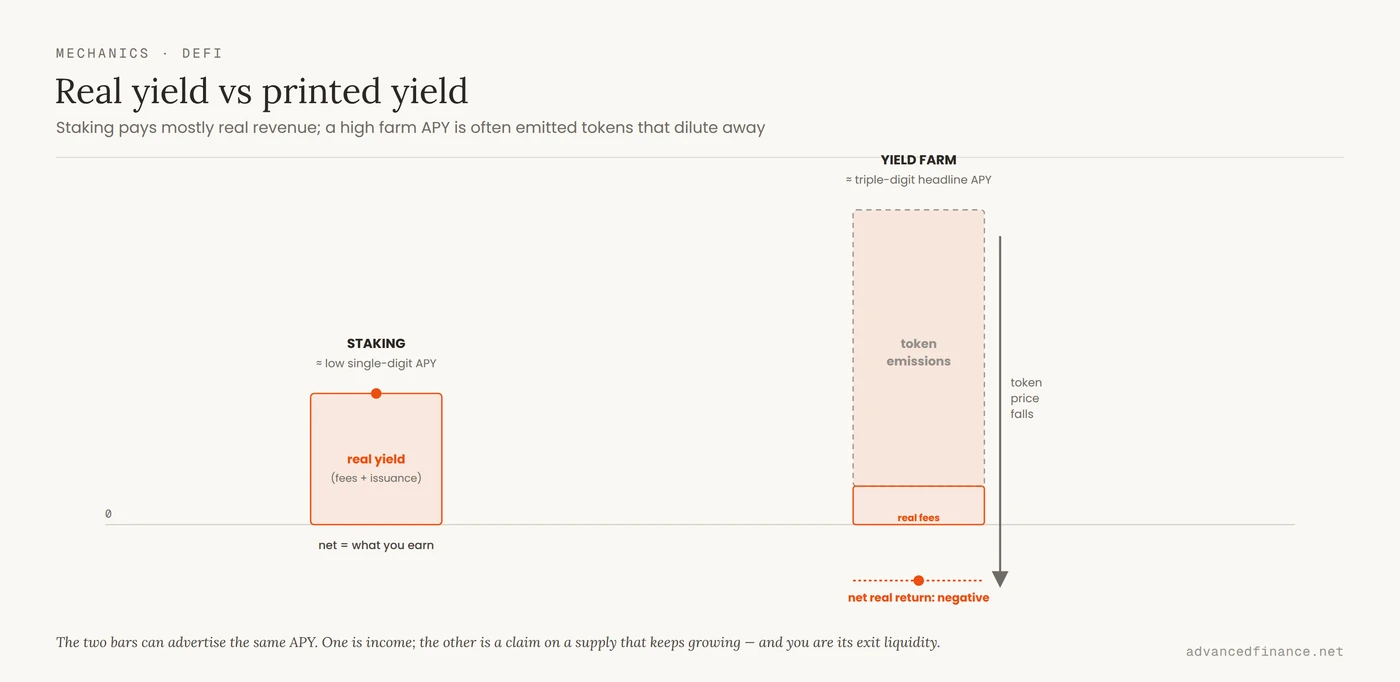
This is the split that decides whether a yield is income or illusion: real yield versus printed yield. Staking mostly pays real yield — issuance and fees the protocol actually generates. A farm’s headline number is often some genuine trading-fee revenue plus a large top-up of freshly minted governance tokens, and those emissions are a claim on a supply that keeps growing. If the token falls in price faster than you earn it, a triumphant 100% APY is a loss in disguise, and you are the exit liquidity for whoever printed it. The single test worth running before you deposit is this: is the protocol earning real revenue, or printing tokens to pay you? The full anatomy of that question lives in where a DeFi yield actually comes from; here it is enough to know that staking leans real and high-emission farming leans printed — and that the size of the APY tells you nothing about which.
The Risks You’re Paid For
Once you accept that a yield is compensation for risk, the honest move is to name the risks on each side. Staking is often called the savings account of crypto, but that is a dangerous simplification — Ethereum’s documentation states plainly that your ETH is at stake, with slashing (larger penalties and ejection from the network) for malicious behaviour and smaller penalties for going offline. A poorly run or dishonest validator can cost you principal, not just yield. Your assets can also be locked through an activation or exit queue, so you cannot always sell into a crash, and liquid staking tokens that solve the lockup add smart-contract risk and the chance the receipt trades below the asset it represents. There is regulatory risk in the convenient version, too: in 2023 the SEC charged Kraken for failing to register its staking-as-a-service program — which had advertised returns as high as 21% — and Kraken paid $30 million and shut the US service down. Staking your own validator is a protocol risk; handing coins to a service is a counterparty and regulatory risk stacked on top. Farming carries a different bundle: impermanent loss (its own section below), smart-contract exploits that can drain a pool in one transaction, and emissions that collapse when the incentive token dies or a governance vote slashes rewards overnight. Loop or lever a farm position and you add liquidation risk — the same loan-to-value math that governs crypto-backed loans and their liquidation thresholds. There is even a tax cost the APY never mentions: in the US the IRS treats staking rewards as ordinary income the moment you gain control of them, and a farmer harvesting rewards every few days simply multiplies those taxable events into an accounting headache.
| Dimension | Staking | Yield farming |
|---|---|---|
| The job | Securing a proof-of-stake chain | Supplying liquidity to a DEX |
| Typical yield | Low single digits to ~10% (chain-dependent) | A few % to triple digits (often emissions) |
| Yield source | Issuance + network fees (mostly real) | Trading fees + token emissions (often printed) |
| Main risks | Slashing, lockup, LST de-peg, service/regulatory | Impermanent loss, contract exploit, emissions collapse |
Impermanent Loss, Honestly
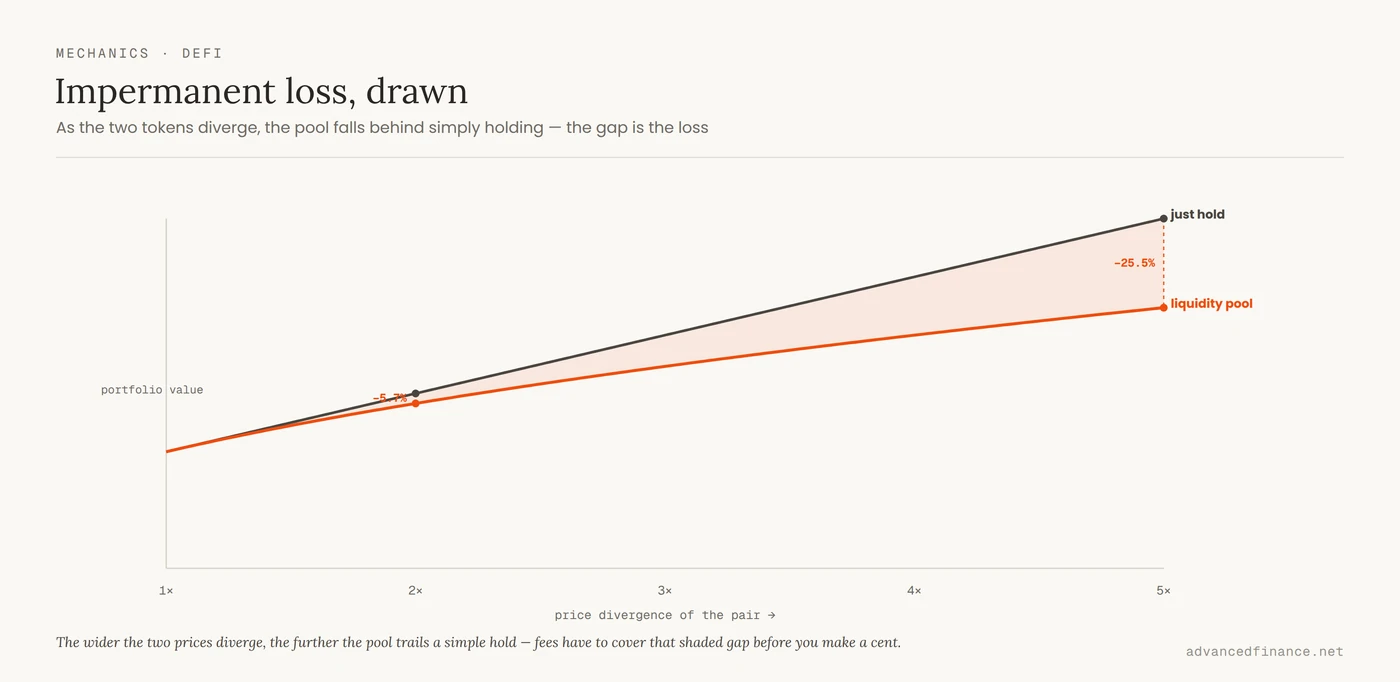
Impermanent loss is the risk farmers underprice most, partly because the name makes it sound temporary and harmless. It is neither. In Uniswap’s own words, impermanent loss is when the prices of the tokens in a liquidity pool change from what they were when you added liquidity, leaving the provider worse off than simply holding the tokens. The mechanism is the quiet part: an automated market maker keeps the pool balanced, so as one asset climbs it sells your winner to buy more of the loser, and you end a strong move holding more of the thing that fell. And you can put a hard number on it — under the standard constant-product formula an AMM uses, the loss depends only on how far the two prices diverge:
| Price divergence | Loss vs holding |
|---|---|
| 1.5× | −2.0% |
| 2× | −5.7% |
| 3× | −13.4% |
| 5× | −25.5% |
Those are losses before fees, so the trading fees and rewards you collect have to exceed the right-hand column just to break even against having done nothing at all. (For the curious, the loss for a price ratio k is 2√k ÷ (1 + k) − 1.) In a trending market — the kind crypto specializes in — that bar is high, which is why simply holding usually beats farming a volatile pair; farming pays best in flat, choppy markets where fees pile up and prices go nowhere. The clean way to sidestep the whole problem is to farm same-asset pairs, such as a staked-ETH token against ETH or one stablecoin against another, where the two sides barely diverge and the loss stays near the top of that table.
How To Actually Choose
Put it all together and the decision stops being “which APY is bigger” and becomes a short interrogation you run on any yield before depositing:
- Real or printed? Weigh the protocol’s actual fee revenue against the dollar value of the tokens it is emitting. If it is printing far more than it earns, treat the APY as an advertisement, not an income.
- What am I paid to risk — and can I survive it? Slashing and lockups, or impermanent loss and a possible contract exploit? Take only the risk you understand and could absorb without it ending you.
- Do I need this liquid? A 21-day unbonding period or an all-in liquidity position is fine right up until the moment you need to sell in a crash and can’t.
- Matched pair or volatile pair? Volatile pairs carry the impermanent loss in the table above; same-asset pairs mostly do not. This single choice changes the risk more than the headline yield does.
- My keys or a service? Self-custodied staking is a protocol risk you control; a staking service or a two-day-old “farm” adds counterparty and regulatory risk on top of it.
For most people the sane default is core-and-satellite: keep the bulk in straightforward staking of a chain you would want to own anyway, and reserve a small, defined satellite for farming you have genuinely vetted — ideally real-yield or matched-pair pools. Treat the whole exercise as what it is, decentralized finance rebuilding bank functions without the bank’s safety net, so the responsibility for risk is entirely yours. When you do farm stablecoins, remember the rate is nothing more than supply and demand for on-chain credit, and treat any pool that launched two days ago promising enormous returns as a rug pull until it proves otherwise, exactly as you would spot any other crypto scam.
FAQ
Is staking safer than yield farming?
Usually, because its risks are narrower and better understood — mainly slashing and lockups — against farming’s stack of impermanent loss, smart-contract risk, and collapsing emissions. But safer is not safe. Ethereum’s documentation is explicit that your ETH is at stake, and using a staking service adds a counterparty risk that self-staking does not carry.
Can I actually lose my principal in staking?
Yes. Slashing can confiscate part of your stake if your validator misbehaves or stays offline, a liquid-staking token can trade below the asset it represents, and a staking service can fail or be forced to shut down. With a careful setup the odds are low, but they are not zero, and treating staked principal as guaranteed is how people get surprised.
Isn’t a huge farm APY just free money?
No. A very high APY is almost always either compensation for a risk you haven’t spotted or a stream of freshly printed tokens. If that emissions token falls in price faster than you earn it, your real return is negative no matter how large the advertised percentage looks.
What is impermanent loss, in one line?
It is the gap between farming a pool and just holding the two tokens: when their prices diverge, the pool leaves you with less than holding would have — about 5.7% at a 2× divergence, 25% at 5× — and the fees you earn have to cover that before you are ahead. It is smallest on same-asset pairs and largest on volatile ones.
What is the smartest approach for a small budget?
Keep it simple: stake a chain you actually believe in, or hold a reputable liquid-staking token, and skip volatile-pair farming, where gas costs and impermanent loss eat small accounts alive. Complexity is a tax, and it falls hardest on the smallest portfolios.
Author’s Insight
After years of doing this, my own strategy has drifted steadily toward boring, and my results improved as it did. I stopped chasing the headline APY once I noticed the farms almost never paid me enough to justify the anxiety, the constant monitoring, and the tax mess of harvesting rewards every week. Now I keep the core of my holdings in plain staking of assets I would want to own regardless of yield, and the only farming I do is on same-asset pairs where impermanent loss is negligible. The extra few percent that a volatile-pair farm dangles has, in my experience, never once been worth waking up to find I was the exit liquidity. Prioritize sleep, custody, and understanding over the biggest number on the screen, and the yield takes care of itself.
Bottom Line
Staking versus yield farming was never really a contest of APYs; it is a choice between two jobs that pay you for two different risks, in money that is either real or merely printed. Staking pays you to help secure a chain and charges you slashing, lockup, and — in its outsourced form — counterparty and regulatory risk. Farming pays you to supply liquidity and charges you impermanent loss you can now put a number on, smart-contract exposure, and the ever-present chance the reward token evaporates. Before you deposit a cent, ask whether the yield is real revenue or emitted tokens, name the risk you are being paid to carry, and confirm you could survive it. Do that, and the question stops being which number is bigger and becomes the only one that matters: which risk are you actually being paid to take, and is the pay worth it?