“Digital gold” is one of the most successful marketing phrases in finance, and like all good marketing it smuggles a conclusion past you. It asks you to accept that because bitcoin is scarce like gold, it will also behave like gold — a calm harbor when everything else is on fire. Those are two entirely different claims, and only one of them survives contact with the data. Bitcoin genuinely shares gold’s scarcity; on the evidence so far it emphatically does not share gold’s behavior. This guide separates the two, because conflating them is how people end up holding their “safe haven” through an eighty-percent crash, wondering why the insurance policy was the thing that burned down. For the record, I own bitcoin and find the scarcity story genuinely persuasive — which is exactly why it is worth being honest about what it is not.
Two Claims in One Phrase
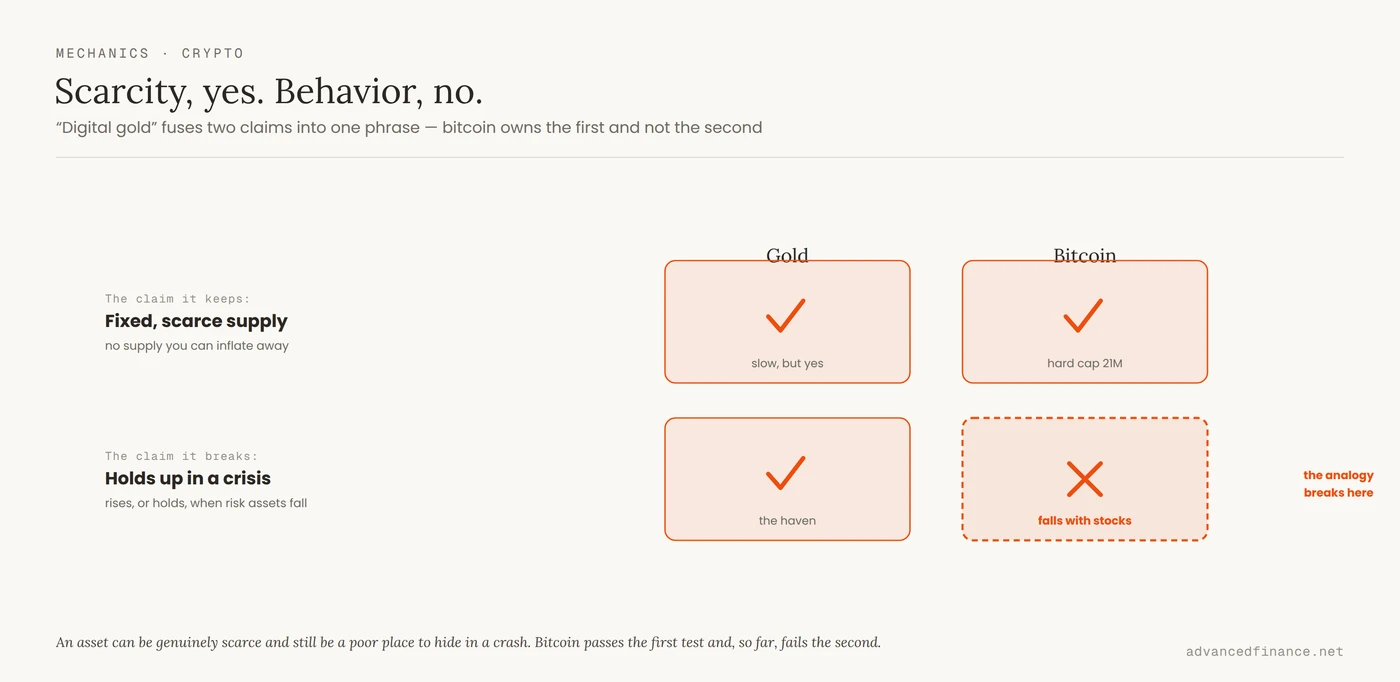
The label “store of value” hides two promises that people treat as one. The first is scarcity: a supply that cannot be inflated away, so your purchasing power is not quietly diluted over time. The second is stability: that the asset holds its value precisely when you need it, staying calm — or rising — while riskier things fall. Gold earns the nickname because it delivers both. Bitcoin has a strong claim on the first and, so far, almost none on the second. Judging it as “digital gold” without pulling these apart is the core mistake, because an asset can be genuinely scarce and still be a terrible place to hide in a crisis. The whole question in the title turns on keeping them separate.
The Scarcity Is Real
Give bitcoin its due, because this half of the analogy is legitimate and it is the strongest part of the case. The protocol caps total supply at 21 million coins and enforces it through a halving schedule that cuts new issuance roughly every four years — the April 2024 halving dropped the block reward from 6.25 to 3.125 bitcoin, with the final coin not due until around 2140. Unlike gold, whose above-ground supply still grows a percent or two a year as miners dig and where a large new deposit is always possible, bitcoin’s ceiling is fixed and auditable by anyone. It is also a bearer asset secured by a decentralized network rather than a vault — weightless, divisible to eight decimal places, verifiable in seconds, and impossible to seize without your keys, properties physical bullion cannot match. If the entire case were “a scarce, portable, censorship-resistant bearer asset,” it would be a strong one. The trouble begins only when scarcity gets quietly upgraded into safety.
But It Trades Like Risk
Here is where the gold analogy breaks. A store of value is supposed to be uncorrelated with risky assets — that is the entire point of a hedge. Bitcoin is the opposite. The IMF found that bitcoin’s correlation with the S&P 500 jumped from just 0.01 before the pandemic to 0.36 in 2020–21, and concluded its diversification benefit had become “limited” — its correlation with stocks now higher than stocks’ correlation with gold. The pattern has held since: across 2023–2025 bitcoin ran roughly a 0.3 correlation with the Nasdaq-100 while gold stayed below 0.15 and kept its negative correlation to stocks — the signature of an actual hedge. In plain terms, gold zigs when stocks zag; bitcoin zigs when the Nasdaq zigs, only harder. It does not trade like money or like a metal. It trades like a leveraged bet on technology and liquidity — which is fine, as long as that is what you call it, and it is not the diversification that portfolio theory actually rewards. And the link is now structural, not a passing phase: since the spot bitcoin ETFs launched, redemptions mechanically force the sale of real bitcoin into the market, so the same institutional flows that move stocks now move bitcoin directly — the double edge of institutional adoption, which is shallower and more constrained than the headlines suggest. In June 2026 Deutsche Bank noted six straight weeks of roughly $6 billion in net ETF outflows amplifying the fall, and described bitcoin as maturing into “an institutional asset whose price is set by fund flows, Fed expectations, competing risk themes, and legislative outcomes”. That is not the description of a safe haven; it is the description of a risk asset wired into the same plumbing as everything else.
| Property | Gold | Bitcoin |
|---|---|---|
| Fixed, auditable supply | Roughly (slow ~1–2%/yr growth) | Yes — hard cap of 21M |
| Portable & censorship-resistant | Poorly (heavy, seizable) | Strongly (keys, not vaults) |
| Correlation to stocks | Low to negative (hedges) | Positive ~0.3 (moves with them) |
| Behavior in a crash | Holds or rises | Falls with risk assets |
| Track record | 5,000+ years | ~16 years |
It Fails When You Need It
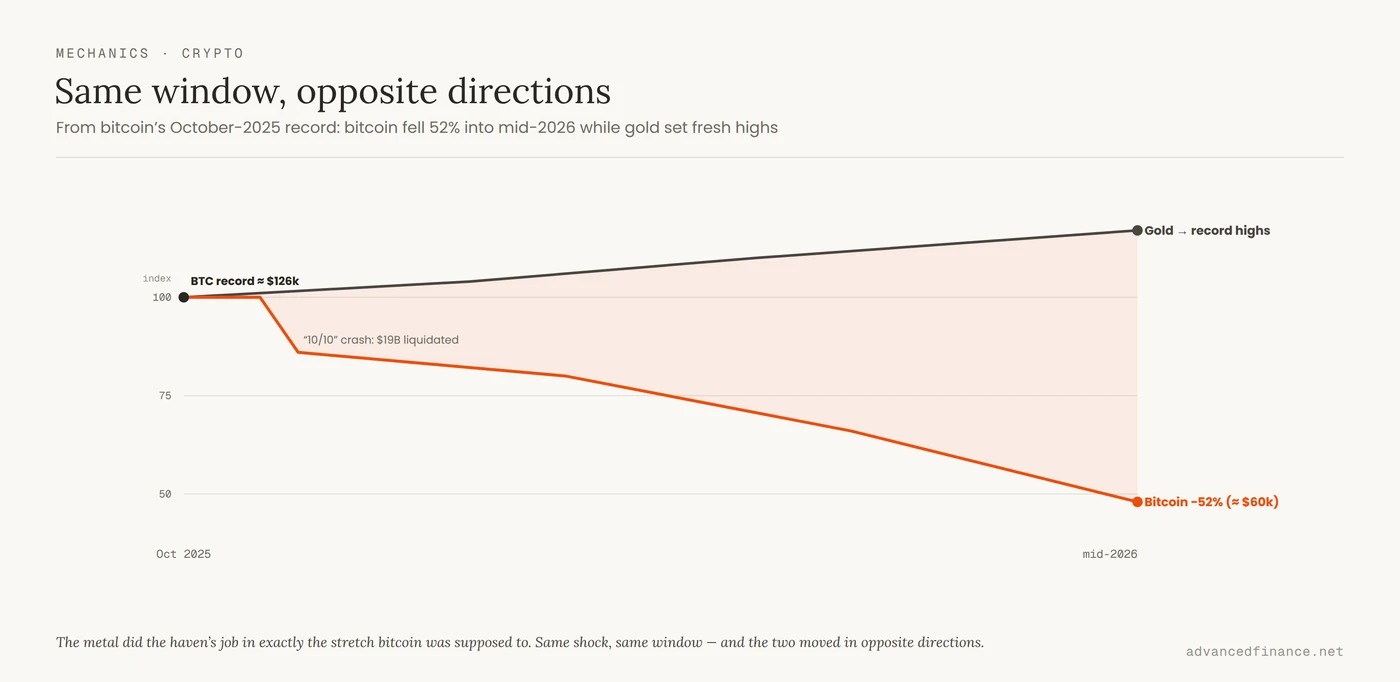
A hedge is judged not on the calm years but on the bad days, and bitcoin’s record on the bad days is the case against “digital gold.” The cleanest proof is the most recent. Bitcoin set a record near $126,000 in October 2025 and then fell more than 50%, bottoming near $60,000 by mid-2026 — and it did so while gold was climbing to record highs on exactly the safe-haven demand bitcoin was supposed to capture. Same window, opposite behavior: the metal did the haven’s job while the “digital” version did the reverse. And the pattern is not new. When markets seized up in the March 2020 panic, bitcoin fell sharply alongside equities in the very liquidity crunch a safe haven is meant to survive; in the 2021–22 downturn it lost 76% of its value from peak to trough through the Terra and FTX collapses; and the 2025–26 slide opened with a single leveraged cascade — the “10/10” crash of October 2025 wiped out more than $19 billion of positions in hours on a tariff headline — before grinding lower as ETF money flowed back out. Each time, the asset marketed as shelter behaved like the storm. An insurance policy that only pays out when you did not need it is not insurance.
| Crisis episode | What bitcoin did |
|---|---|
| March 2020 COVID crash | Fell sharply, alongside equities |
| 2021–22 (Terra, FTX, inflation) | −76% peak to trough |
| 2025–26 (10/10 crash → ETF outflows) | −52% ($126k → ~$60k); gold hit records |
The Inflation-Hedge Myth
The most confident version of the story is that bitcoin’s fixed supply makes it a hedge against inflation. It sounds airtight, and it failed its first real test in public. 2022 brought the worst US inflation in four decades — and bitcoin fell 76% that cycle, its single worst drawdown, precisely as the inflation it was supposed to guard against was peaking. Scarcity and inflation-protection are not the same thing: a scarce asset can still lose two-thirds of its purchasing power if frightened holders sell it to raise cash, which is exactly what happened. This is also where the popular “stock-to-flow” scarcity model quietly died — it projected six-figure prices from the shrinking new supply, and reality ignored it, because a supply schedule does not set a price. Supply and demand do, and demand for a risk asset evaporates the moment money gets tight. Scarcity is a reason bitcoin might hold value over decades. It is not a reason it will protect you in any particular year.
How To Actually Hold It
None of this means bitcoin is worthless; it means holding it honestly. Treat it as what the data says it is — a small, high-volatility, high-upside bet on continued adoption, not the ballast that keeps a portfolio upright in a crash. That single reframing changes how you size it. It belongs in the risk-capital corner of a portfolio, alongside your most speculative holdings, not in the safe corner where cash and real hedges live; a position you could watch fall eighty percent without it altering your life. Do not lend it out chasing an extra few percent, either — the yield offers that ended in the Celsius and Voyager collapses were re-hypothecation dressed up as income. Remember that as a long-duration risk asset it is acutely sensitive to the cost of money, which is why it fell hardest exactly when a positive real interest rate returned. And keep in mind that its legal identity is still being drawn, mostly on the commodity side of the regulatory line. Own it if the scarcity thesis convinces you — but size it as the volatile bet it is, and keep a genuine hedge for the job bitcoin has not yet proven it can do.
FAQ
Is bitcoin a good hedge against inflation?
Not on the evidence so far. In 2022, during the worst US inflation in forty years, bitcoin fell about 76%. A fixed supply protects against dilution over the very long run, but it plainly did not protect purchasing power in the year inflation actually spiked.
Does bitcoin move with the stock market?
Increasingly, yes. The IMF measured its S&P 500 correlation rising from 0.01 before the pandemic to 0.36 in 2020–21, and it has since run around 0.3 with the Nasdaq-100. It behaves like a high-beta technology stock, not an independent store of value.
Is bitcoin’s scarcity real, or just hype?
Real. The protocol caps supply at 21 million coins and enforces it through halvings — the 2024 halving cut new issuance to 3.125 bitcoin per block. Scarcity is the strongest part of the “digital gold” case; the weak part is behavior, not supply.
So is bitcoin a store of value or not?
It is a scarce asset, but not yet a reliable store of value in the way gold is, because it loses value hardest in the crises when a store of value is supposed to hold. That verdict is about behavior so far, not a permanent law: its realized volatility has trended down as the market matures, and some analysts — JPMorgan among them — argue a calmer bitcoin could grow more gold-like over time. The test is whether it ever holds up through an actual risk-off crisis rather than a calm stretch. Until it does, it is better understood as a volatile long-term bet on adoption than as safe ballast.
How much bitcoin should I hold?
That is personal, but the honest framing is to size it as risk capital — an amount you could watch fall eighty percent without derailing your plan — and not to count it as the defensive part of your portfolio, which still needs assets that actually hold up in a panic.
Author’s Insight
I own bitcoin, and I want that on the table before I say the rest, because the honest position here is easy to mistake for hostility. What changed my mind was not the bull case, which I found persuasive, but watching my “safe haven” fall in lockstep with my technology stocks every single time the market got scared. After the third time, I stopped pretending it was insurance and started treating it as what my own account statements plainly said it was — the most volatile thing I owned, not the calmest. That reframing made me a better holder, not a worse one: I sized it as a bet I could survive being wrong about, stopped expecting it to rescue me in a crash, and kept real hedges for that job. I am still long. I am just long the actual asset, not the slogan attached to it.
Bottom Line
“Digital gold” is a brilliant phrase that answers a question it never actually asks. Bitcoin does share gold’s scarcity — a fixed, auditable, censorship-resistant supply that is the real strength of the case. What it does not share, on every piece of evidence we have, is gold’s behavior: it trades like a leveraged technology bet now wired into the same ETF and institutional flows as stocks, and in each of the last crises — March 2020, the 2022 inflation shock, and the 50%-plus slide from its October 2025 record while gold set fresh highs — it fell with risk assets rather than sheltering you from them. Hold it if the long-run scarcity thesis convinces you, but hold it honestly: as a small, volatile bet on adoption, sized as risk capital, not as the safe harbor its nickname promises. Call the asset what it actually is, and it becomes far easier to own well.