The most common advice on trading psychology is to "master your emotions" and "overcome fear and greed." The better sources have moved past that, and so should you — because the advice fails at the exact moment you reach for it. Self-control is a depletable resource, and nothing drains it faster than a fresh loss. Willpower is weakest right after a drawdown, which is precisely when fear and greed take the wheel.
So this piece takes a different line. You cannot overcome fear and greed by resolve. You can only do two things: remove the moments where they get to touch the order button, and learn to read the crowd's fear as information rather than catch it. Everything below is built on that split — discipline you install in advance, not discipline you summon in the heat of a trade.
Fear and Greed Don't Create Edge
Start with what psychology can and can't do. It cannot manufacture an edge; it can only protect one you already have. The setups, the statistics, the reason your trades make money over a large sample — that is where a trading edge actually comes from. Emotion doesn't add to it. Emotion only ever subtracts.
The subtraction has a name in the research. Studying thousands of real brokerage accounts, Terrance Odean documented the "disposition effect": investors sell their winners too early and hold their losers too long (Odean, 1998, Journal of Finance). That is fear and greed in one sentence — greed to lock in the good feeling of a win, fear of admitting a loss is real. Both instincts work directly against the math, because a strategy only pays if you let winners run and cut losers short.
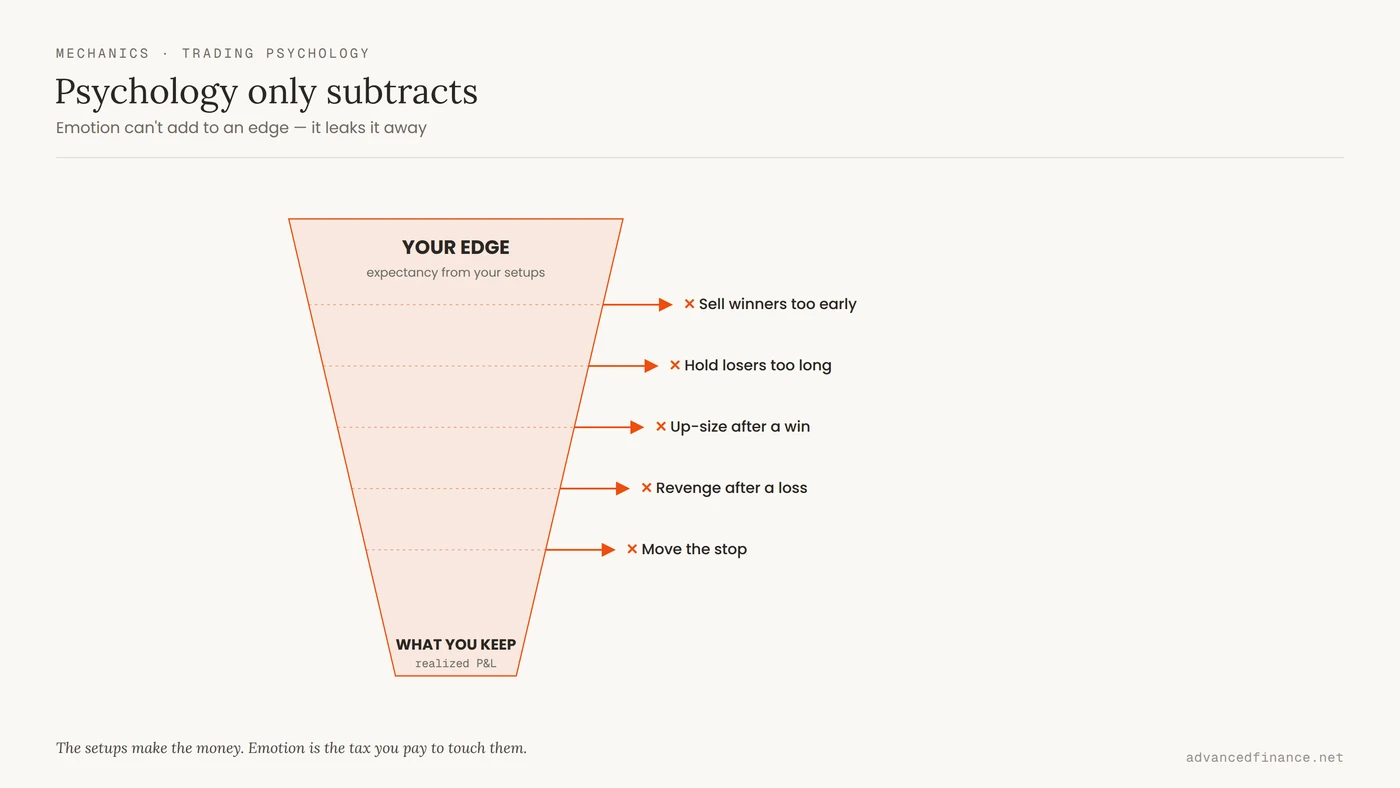
This is also why a system with a middling hit rate can still be highly profitable: it's the size of the winners versus the losers that decides the outcome, not how often you're right. That is the whole argument behind why win rate matters less than your reward-to-risk. Every time emotion trims a winner or nurses a loser, it quietly inverts that geometry.
Willpower Fails When You Need It
Here is the uncomfortable truth that "just be disciplined" ignores: self-control is not a constant. It is depleted by stress, and nothing depletes it faster than a fresh loss. The moment you most need to follow your plan — down two trades, nervous system lit up, certain the market owes you one — is the moment you have the least willpower available to do it.
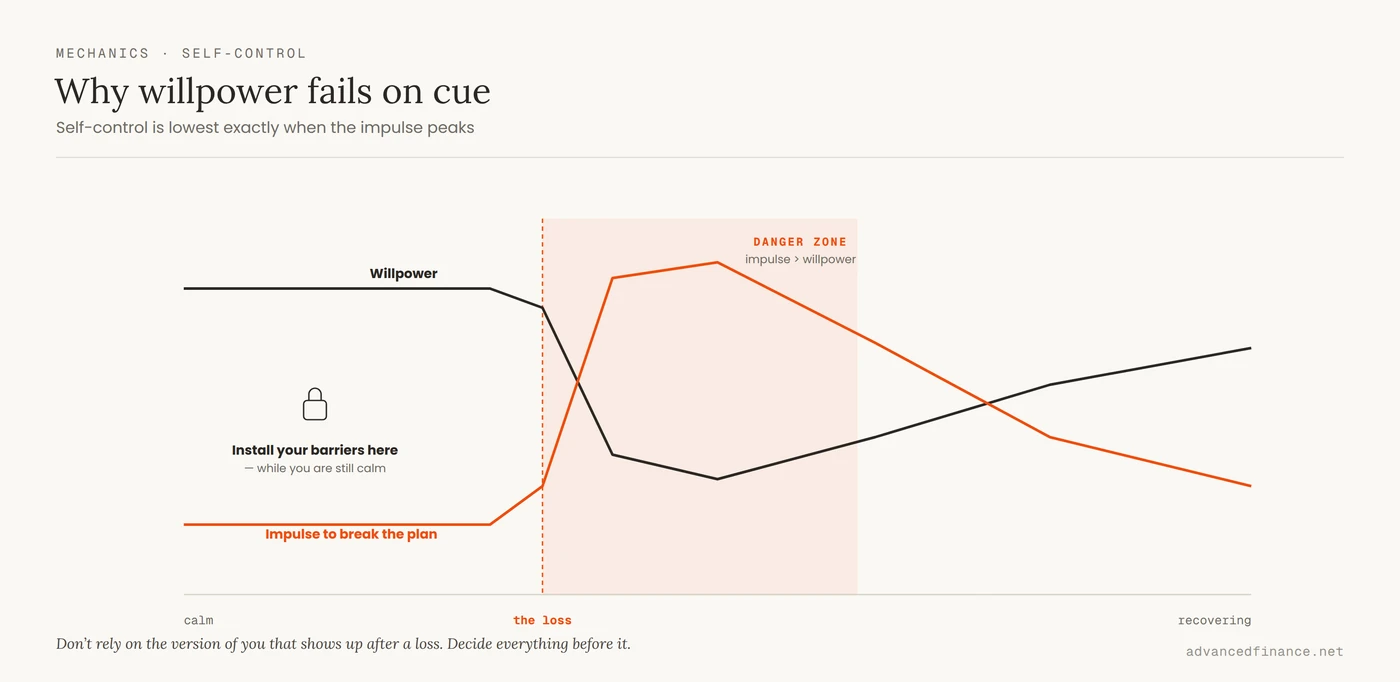
Revenge trading survives for exactly this reason. It isn't a character flaw; it's a predictable response of a stressed brain with an open platform in front of it. If your only defense is a promise you made to yourself when you were calm, that promise will lose to the impulse every time it counts.
The conclusion is not "try harder." It's to accept that the in-the-moment version of you cannot be trusted, and to hand the important decisions to the calm version of you who acts in advance. That single reframe — from resolve to pre-commitment — is what the rest of this article is about.
Size So Fear Never Spikes
The most powerful fear-suppressant isn't a breathing exercise. It's position size. Fear spikes when the amount at stake feels like it matters; if a single loss is a genuine non-event for your account, the emotion never gets large enough to hijack you. Get the size right and half the psychology problem disappears before it starts.
The mechanical rule is to risk a fixed, small slice of the account on any one trade, and to let the share count fall out of the math rather than picking it first:
Shares = (Account × Risk %) ÷ (Entry price − Stop price)
On a $25,000 account risking 1%, that's $250 of risk. With an entry at $150 and a stop at $145, you're risking $5 a share, so the position is 50 shares — and a full stop-out costs $250, an amount you should feel almost nothing about. If that loss would sting, the position is too big; cut it until it doesn't. Treating 1% as a ceiling rather than a target is the core of the risk management that keeps a loss survivable, and a survivable loss is one your emotions can shrug off.
Read the Market's Fear
Your own fear is a liability. The crowd's fear is information — and unlike a news headline, it can be measured. When everyone is afraid at once, prices are usually already marked down; when everyone is greedy, the easy money is usually gone. The trick is to treat these gauges as regime filters, not timing signals.
Three are worth watching. The VIX is the market's option-implied estimate of near-term S&P 500 volatility — effectively the price of fear (CBOE, VIX). CNN's Fear & Greed Index compresses seven different market signals into a single 0–100 score, from extreme fear to extreme greed (CNN Business). And the put/call ratio shows whether the crowd is paying up for protection or for upside. None of them tells you what happens tomorrow; together they tell you what regime you're trading in.
| Volatility (VIX) | What the crowd is doing | How I adjust |
|---|---|---|
| Calm (roughly the teens) | Complacent, positioning freely | Trade valid setups at normal size |
| Elevated (20s) | Nervous, stress rising | Trim size, tighten the watchlist |
| High (30s) | Real fear, selling into weakness | Build a shopping list; buy only on price confirmation, in small tranches |
| Extreme (40+) | Panic, forced selling | Smallest size, wider stops, accept gap risk |
The one rule that ties it together: as the crowd's fear rises, your conviction may rise with it — but only if your size falls. Buying into a panic is sound; buying into a panic at full size is how a good idea still blows up the account.
Barriers Beat Discipline
If the in-the-moment version of you can't be trusted, the answer is to build barriers the calm version installs ahead of time. These are not motivational tricks; they are physical obstacles between an impulse and a filled order. Each of the classic emotional errors has one:
| Emotional error | What it looks like | The barrier that stops it |
|---|---|---|
| Revenge trading (loss aversion) | Sizing up right after a loss to win it back | Hard lockout after two losses — the platform closes |
| FOMO | Chasing a move that already ran, with no setup | Written entry checklist: no named setup, no trade |
| Overconfidence after a win | Up-sizing because you feel hot | Fixed % risk — size is an output, never a mood |
| Moving the stop | Widening the stop to avoid being wrong | Stop set in the platform at entry, never widened |
| Overtrading / boredom | Taking trades just to be in the market | One-sentence-thesis gate; the HRV brake below |
Write the rules before the session
Vague criteria like "it looks strong" are an open door for emotion to rewrite the plan mid-trade. Specific ones close it: an entry is only valid if it meets a written, testable condition — a breakout from a defined range on above-average volume, with the stop at a named level. This is the same discipline behind the day-trading mindset that keeps you flat and deliberate: if you can't state the setup in one sentence, you don't have one.
Run a pre-mortem
Before you enter, assume the trade has already failed. Psychologist Gary Klein calls this a "pre-mortem" — imagining the failure has happened and working backward to explain it, which surfaces risks that optimism hides (Klein, Harvard Business Review). Two honest questions catch most bad trades: am I entering because of the setup, or to recover the last loss? And would I take this exact trade if I had no position and no P&L to avenge? Writing the answer slows the impulse just long enough for judgment to catch up.
Lock the door after losses
Decide in advance that after a set number of consecutive losses — two is a reasonable line — you are done for the session, and enforce it with something stronger than intent: close the platform, use a website blocker, disconnect the order panel. And take the dollars off the screen while you trade. A flashing dollar P&L is pure emotional fuel; watching risk in R-multiples (−1R, +2R) instead lets you see the trade as a unit of a plan rather than money leaving your pocket. A trade that risks $250 to make $500 is simply a +2R win whether your account is $25,000 or $250,000 — the number you react to stays the same.
Keep an honest journal
Barriers only improve if you can see where they leak, which is what a journal is for. Log each trade's setup, entry reason, stop, planned risk, actual exit, and the line most traders skip: whether you followed your own rule. Then log the trades you didn't take — that's the only way to tell disciplined patience from fear-driven paralysis. Review weekly for rule-breaks rather than for profit: a loss that followed the plan is tuition, while a win that broke it is a bad habit quietly being trained.
When Your Body Says No
There's a physical layer under all of this. Your capacity to self-regulate isn't fixed day to day — it tracks your physiological state, and heart-rate variability (HRV) is a reasonable proxy for it. Higher resting HRV is associated with better self-regulatory and cognitive control; low HRV, poor sleep, and high stress pull in the opposite direction (peer-reviewed review, Frontiers in Psychology). In plain terms: on a badly under-recovered day, the part of you that follows rules is running on less.
Used honestly, a wearable that measures overnight HRV is a brake, never a crystal ball — it says nothing about market direction, only about whether you are fit to trade it. The rule I follow is one-directional: compare this morning's reading to my own baseline, and if it's clearly down, I cut size or don't trade at all. I never let a great HRV score talk me into more risk. Physiology can take the keys away; it doesn't get to hand out extra.
FAQ
How do I actually stop revenge trading after a loss?
Not with a promise — with a lock you set while calm. In practice that means a website or app blocker on your broker and charts, a broker-level daily-loss limit that flattens and freezes the account past a set drawdown, or a prop-firm dashboard that enforces one for you. Pick the trigger in advance — two consecutive losses is a reasonable line — because in the flooded state right after a loss, the only thing that reliably works is being unable to place the trade.
Does the Fear & Greed Index actually work as a signal?
As a regime filter, not a timing tool. Read each gauge against its own recent history rather than a fixed number — a put/call ratio in the top decile of its past year says far more than any universal threshold. Extreme fear can persist for weeks, so let the reading set your size and selectivity, then demand price confirmation on the individual trade before acting. It tells you the weather, not the minute the storm breaks.
How much should I risk per trade?
Little enough that the loss is boring. A common convention is to treat 1% of equity as a ceiling and start below it — roughly a quarter to a half percent while you're still building a track record. Better still, stop counting dollars and count R: if one unit of risk (1R) is a fixed, small slice of the account, every trade is just a bet measured in Rs and the dollar figure never gets a chance to frighten you. If the potential loss creates tension before you enter, it's too big.
Can a wearable really improve my trading?
Only as a brake. Build a simple baseline — your average overnight HRV over the last week or so — and act in one direction only: if this morning's reading sits clearly below that normal range, cut size or skip the day; if it's high, change nothing. The entire benefit is in the trades you don't take on a frayed, under-slept nervous system. It never predicts the market, only your fitness to trade it.
Why do profitable strategies fall apart when I trade them live?
Because you quietly change the strategy without noticing. A backtest takes every signal identically; a nervous human skips valid trades after a loss, takes invalid ones after a win, moves stops, and books winners early. The cure is to make the deviations visible: journal not just your trades but the valid ones you skipped, review weekly for rule-breaks rather than P&L, and let the structural barriers above catch the rest.
Author's Insight
After years of doing this, I've concluded that the biggest risk on my book is me. I can build a sound system, test it thoroughly, and still hand back the profits in a handful of emotional trades after a bad morning. What changed my results wasn't becoming calmer or more disciplined in some heroic way — it was accepting that I will, at some point, lose control, and building the cage before that happens. I decide my rules when I'm calm, I size so no single loss can rattle me, and I make it physically hard to break my own plan when the calm runs out. That's not weakness; it's just taking my own psychology seriously as the largest variable in the account.
Bottom Line
You will never overcome fear and greed, and chasing that goal keeps you fragile. What you can do is make them irrelevant: size every trade so a loss can't frighten you, read the crowd's fear as a regime rather than catching it, and install mechanical barriers — written rules, a pre-mortem, a post-loss lockout, R-multiples instead of dollars — that your calmer self controls. Psychology never creates the edge; it only decides how much of it survives contact with a live market. Protect the edge by trusting your systems over your in-the-moment instincts, every single time.